
Knowledge Centre · Choosing your oven
What Size Pizza Oven Do I Need? A Practical South African Buyer’s Guide
For most South African homes, a pizza oven with a 70 cm internal cooking floor is the size we recommend most often. But the right size for you is rarely decided by how many pizzas fit inside. Here is how to choose, from the team that builds the ovens.
In our experience advising customers, three things matter far more than pizza count:
- The space you actually have, including room for your braai and a worktop.
- What you want to cook. Only pizza, or roasts, bread, vegetables and pans as well?
- How you will use it. Quiet family nights, or regular entertaining with friends taking turns at the oven?
Two more questions catch people out later: how the oven will physically get to its final position, and whether you are buying for your home or for a business. We cover both below.
The quick answer: 60 cm vs 70 cm vs 90 cm
The size in an oven’s name (60, 70 or 90) refers to the internal cooking floor. Pizza counts assume a large pizza of about 30 cm and are approximate physical fits, not a promise of how many pizzas you should cook at once.
| Internal size | Eco models | Pizzas that physically fit (approx.) | Best suited to | Main advantage | Main consideration |
|---|---|---|---|---|---|
| 60 cm | Piccola 60 | About one, comfortably | Smaller patios and braai areas | Compact; fits where a 70 won’t | Less room for a pan or tray next to a pizza |
| 70 cm | Piccola 70, Mezzano 70 | About two | Most family homes | Good balance of size and working room | Needs a bigger base than many expect (from 100 x 100 cm) |
| 90 cm | Mezzano 90 | About three | Regular entertainers and keen cooks with the space | The most room to cook several things at once | Largest footprint (120 x 130 cm) and the heaviest oven to move |
Base sizes are the minimums from our Compare Our Ovens page, where you can also download the spec sheets.
Why 70 cm is such a popular size in South Africa
The Piccola 70 has long been one of our most popular residential ovens, and the reason is usually space, not capacity.
Most South African outdoor areas have to fit a braai, somewhere to prepare food, and now a pizza oven as well. A 70 cm oven gives you a proper working floor without taking over the whole entertainment area. A substantially bigger oven often simply won’t fit alongside everything else.
If you like a more traditional look, the Mezzano 70 has the same 70 cm internal size with an extended front, which gives a slightly larger usable cooking floor. Its base needs to be a little deeper (100 x 110 cm against 100 x 100 cm for the Piccola 70). See the Piccola and Mezzano pages for both.
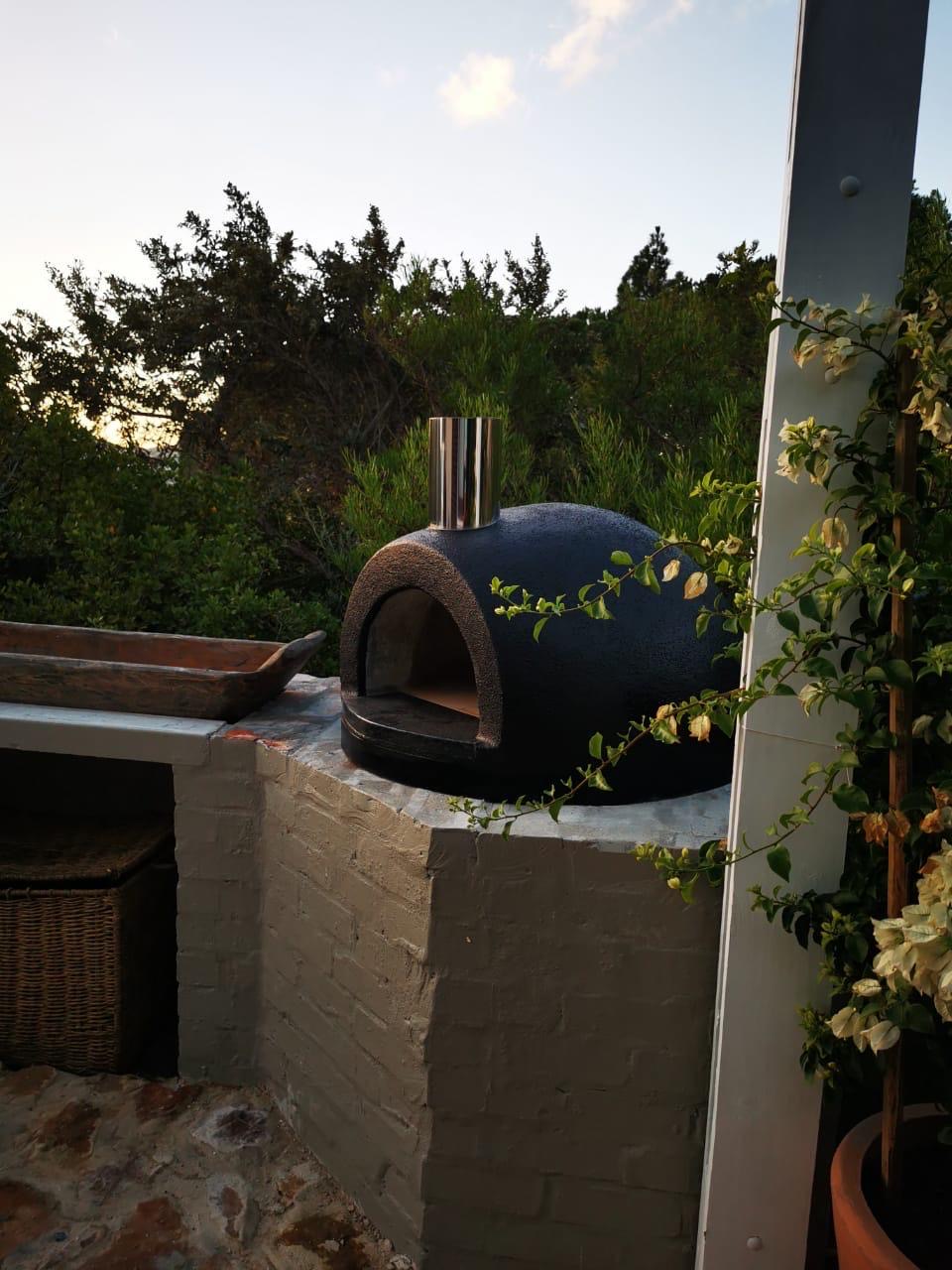
When a 60 cm oven is the better choice
If your space can’t comfortably take a 70 cm oven, we recommend the Piccola 60 rather than squeezing in the bigger model.
We regularly speak to customers who would prefer the 70 and look for ways to make it fit an undersized base or a tight corner. We advise against it. An oven that hangs over its base or crowds the braai looks like the project wasn’t planned properly, and it is less comfortable to work at. A correctly proportioned Piccola 60 is the better result.
It also helps to know that if you mainly plan to cook one pizza at a time, the day-to-day difference between a 60 and a 70 is smaller than most people imagine. The extra space in a 70 really pays off when you want a pan, tray or second dish in the oven next to your pizza.
When it makes sense to choose a 90 cm oven
A bigger oven is not mainly about making more pizzas at once. For a home cook, the real benefit of a larger cooking floor is working room and flexibility.
If you have the space, we are more likely to recommend a 90 cm oven (the Mezzano 90) when someone tells us they:
- entertain regularly, or host pizza evenings
- enjoy cooking and don’t only want to make pizza
- want to roast meat, cook vegetables or use pans and trays
- want to cook several things at the same time
- expect family and friends to take turns using the oven
That last point matters more than people expect. The extra floor area makes life easier for less experienced cooks, because there is more room to move food away from the fire.
As an example, for a family of four who entertain often and have room for the larger base, we would generally lean towards the 90 cm option for its versatility. That isn’t a rule: space and how you plan to cook still decide it.
If you would like more working room but can’t fit a 90 cm oven, the Mezzano 70 is worth a look. Its extended front gives a slightly larger usable floor than the Piccola 70, within a much smaller footprint than the Mezzano 90.
How many pizzas can you actually cook at once?
There is an important difference between how many pizzas physically fit and how many pizzas a home cook can manage at the same time.
At full temperature, a pizza cooks in around two minutes. During that time it needs your attention: you turn it relative to the fire so one side doesn’t burn while the other is still undercooked.
That is why, even though a 70 cm oven can physically hold two large pizzas, we often suggest that new owners learn by cooking one pizza at a time. Managing two or three at once takes practice. Once you are confident, a bigger floor gives you the option. Until then, one well-cooked pizza every couple of minutes feeds a family surprisingly quickly.
So a bigger oven doesn’t simply mean more pizzas. For most home users, the benefit is extra space and versatility.
Think beyond pizza: what else will you cook?
If you find yourself saying, “I don’t only want to make pizza,” take that as a sign a larger cooking floor may suit you better.
A wood-fired oven is a very capable outdoor cooker. With enough room on the floor, you can have a pizza cooking while you also use:
- a cast-iron pan for steak, fish or vegetables
- roasting dishes for meat or potatoes
- bread
- desserts and other baked dishes
This is where the extra space in a 70 cm, and especially a 90 cm, oven becomes genuinely useful. You are no longer juggling one thing at a time.
Does a bigger pizza oven use more wood?
Yes. A larger masonry oven generally takes a little longer to heat and uses somewhat more wood.
For occasional home use, though, the difference between residential sizes is usually small. You might add a few more pieces of wood and wait a bit longer for the bigger oven to come up to temperature. In our experience that shouldn’t be the main reason to choose one size over another.
Wood use becomes far more important in a commercial kitchen, where an oven may be fired every day. There, the difference between oven sizes adds up over weeks and months, and it is one more reason commercial ovens need to be sized carefully.
Residential vs commercial pizza oven size
We often hear from people starting a takeaway, restaurant or pizza business who want to buy a residential oven because it costs less. A common question is whether a residential 90 cm oven can handle five or six pizzas at once during service.
That isn’t what a residential oven is designed for. During a busy service, loading pizza after pizza pulls heat out of the cooking floor. The floor drops in temperature, cooking times get longer, and it becomes harder to manage pizzas close to the fire. Some customers start with a residential oven on a tight budget, then come back once they have outgrown it.
If you are going to sell pizza, size the oven for the demand you expect during your busiest periods, not by picking the biggest home oven available. Eco builds commercial wood-fired ovens in two sizes: a 1.2 m oven that takes about six large pizzas at a time, and a 1.4 m oven that takes up to ten. Each project starts with a conversation about your menu, kitchen layout and expected service.
Internal size vs the space you actually need
This is one of the most common planning mistakes.
The size in the name is the internal cooking floor, not the space the oven takes up. The walls, insulation and structure of a masonry oven add considerably to its external size. A Piccola 70, for example, has a 70 cm cooking floor but needs a base of at least 100 x 100 cm.
| Model | Internal diameter | Minimum base (W x D) |
|---|---|---|
| Piccola 60 | 60 cm | 90 x 90 cm |
| Piccola 70 | 70 cm | 100 x 100 cm |
| Mezzano 70 | 70 cm | 100 x 110 cm |
| Mezzano 90 | 90 cm | 120 x 130 cm |
So if you are planning an outdoor kitchen, don’t tell your architect or builder, “I’m getting a 70 cm oven, leave me 70 cm.” Give them the actual base requirements for the specific model. Our Base & Planning guide has straight and corner base plans, and the spec sheets on the Compare Our Ovens page include dimension drawings you can pass on to your builder.
If an architect has designed your entertainment area, you are welcome to send us the plans and we will help you work out which oven fits. If there is no architect involved, we can help with practical positioning.
One layout that works well in many homes is:
Pizza oven → shared worktop → braai
The worktop in the middle serves both cooking areas, so you can prep pizzas and braai food in the same place. It is a useful starting point rather than a rule; your space will decide what works.
Don’t forget access to your property
This is the question many people only ask after they have chosen their oven: how is it actually going to get to where it is going?
Our ovens are heavy masonry, and most residential ovens are delivered fully assembled on a pallet. Before you settle on a model, walk the route from where the delivery vehicle will stop to the oven’s final position and check:
- gates and their opening width
- pathways and passages
- steps and changes in level
- tight corners
- the distance from the delivery point to the entertainment area
- whether an assembled oven can physically get through every part of that route
Measure the narrowest point. If you are planning to carry the oven by hand, you will need at least four people for the Piccola 60, Piccola 70 or Mezzano 70, and at least six for the Mezzano 90. Suitable lifting equipment or professional handling is the safer option.
We often ask customers to send photos or a short video of the access route. Depending on what we see, an assembled oven may be fine, or a kit may be the better option. In Cape Town, we can also assemble the oven on site. The right approach depends on your property, so it is worth speaking to us before you finalise the project. Our Delivery & Installation page explains the options.
A note on maintenance
Some buyers fall in love with the look of a traditional dome oven without realising that a masonry oven needs looking after. It has to be cured properly before its first full-heat cook, it needs ongoing care, and small cosmetic hairline cracks can appear as it heats and cools (see our care and maintenance guide). Many people still choose masonry precisely for that traditional look and feel. Just go in knowing what is involved.
How we help customers choose the right size
Most of our customers don’t arrive knowing exactly which oven they need, and that is fine. Choosing well is usually a short conversation about:
- the space you have, and what else needs to fit there (braai, worktop, seating)
- what you like to cook, and how often you entertain
- the access route to the oven position
- your location, for delivery
Frequently asked questions
Is a 60 cm pizza oven big enough for a family?
For a family that mainly cooks one pizza at a time, yes. A 60 cm oven fits about one large pizza comfortably, and pizzas cook in around two minutes at full heat. It is the right choice when your space can’t properly fit a 70 cm oven. If you want room for pans or trays next to your pizza, a 70 cm oven gives you more flexibility.
Is a 70 cm pizza oven big enough?
For most South African homes, yes. It is the size we recommend most often. It balances cooking space with a footprint that fits alongside a braai and worktop.
How many pizzas fit in a 70 cm pizza oven?
About two large (30 cm) pizzas can physically fit. We still suggest beginners cook one at a time, because each pizza needs turning during its roughly two-minute cook.
How many pizzas fit in a 90 cm pizza oven?
About three large pizzas can physically fit. For home cooks, the bigger benefit is the extra room to cook pizza alongside pans, roasts and other dishes.
Is a bigger pizza oven always better?
No. A bigger oven needs a bigger base, more space and a little more wood. If it doesn’t fit your area properly, a smaller, well-proportioned oven is the better choice.
Does a bigger pizza oven use more wood?
Somewhat. A larger oven takes a little longer to heat and uses a few more pieces of wood. For occasional home use the difference is small; it matters much more in a commercial kitchen used every day.
What size pizza oven is best for entertaining?
If you entertain regularly, want to cook more than pizza and have the space, a 90 cm oven gives you the most working room. If space is limited, the Mezzano 70 offers a slightly larger usable floor than the Piccola 70.
Can I use a residential pizza oven for a restaurant?
We don’t recommend it for regular commercial service. Loading many pizzas in a row pulls heat from the floor and slows cooking. Size a commercial oven for your expected demand during your busiest periods. Eco’s commercial ovens come in 1.2 m (about six large pizzas at a time) and 1.4 m (up to ten).
How much space do I need for a pizza oven?
More than the size in the name. The minimum bases are 90 x 90 cm (Piccola 60), 100 x 100 cm (Piccola 70), 100 x 110 cm (Mezzano 70) and 120 x 130 cm (Mezzano 90). Then allow room for a worktop and to work comfortably in front of the oven.
Can a pizza oven be installed if access to my backyard is restricted?
Often, yes. If an assembled oven can’t get through your gate, doorway or path, a kit may be the answer, and in Cape Town we can assemble on site. Send us photos or a video of the route and we will advise.
Not sure which size will fit?
Send us photos and measurements of the space, or a short video of the area and the access route, and we will help you work out which option is practical.